Land Clearing
Full-scale clearing for development, farming, or recreation. We remove trees, stumps, and debris and leave a flat, usable surface ready for its next purpose.
View Service
Our Primary Service
One machine. One pass. Trees, brush, stumps, and undergrowth ground to nutrient-rich mulch — no hauling, no burning, no second trip.
How It Works
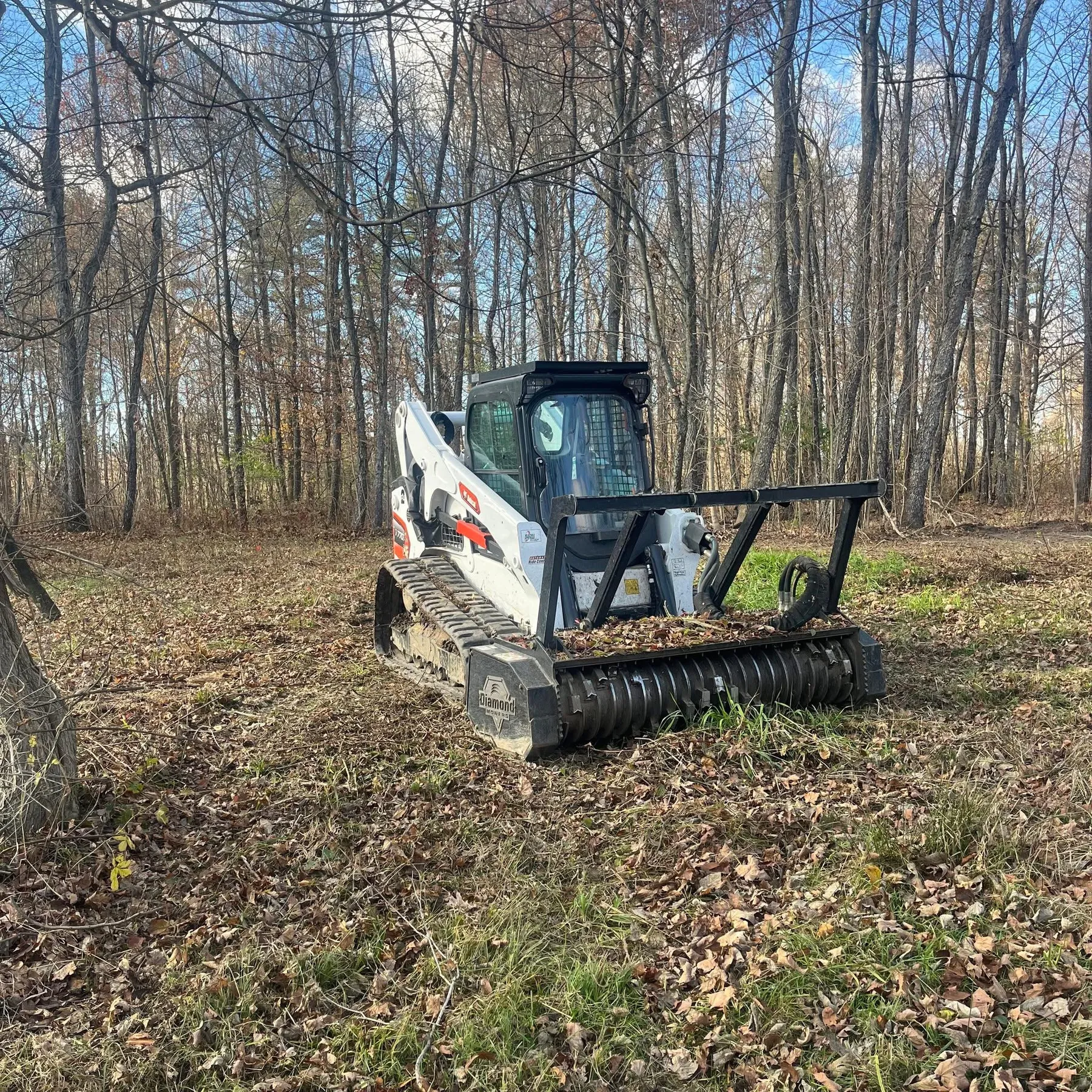
Forestry mulching uses a track skid steer fitted with a high-torque rotary mulcher head to process vegetation directly in place. The drum — studded with hardened carbide teeth — spins at high speed and shreds trees up to 8–10 inches in diameter, dense brush, invasive vines, and root systems into fine woody mulch in a single forward pass.
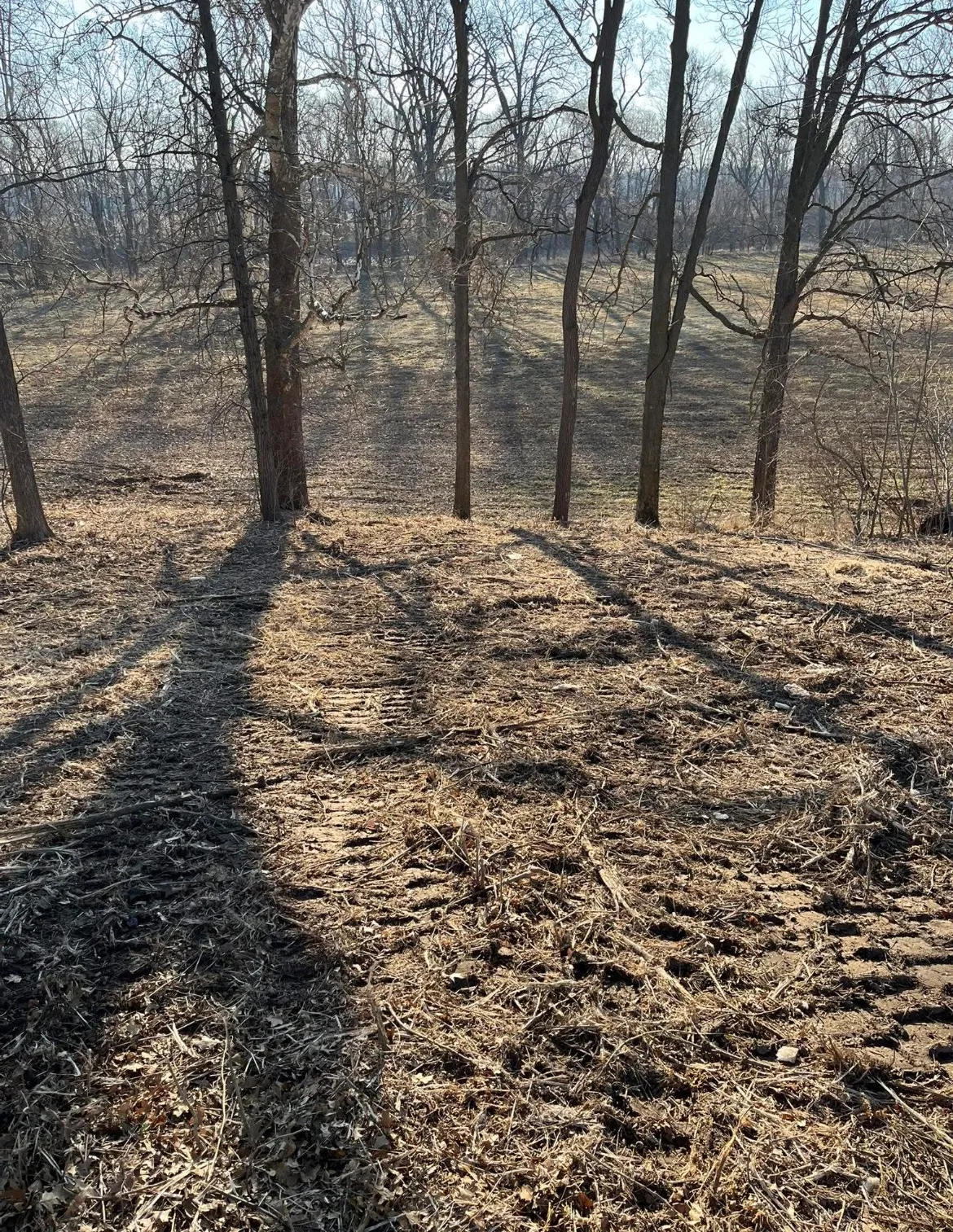
Unlike bulldozing, which pushes material into piles that must be burned or hauled, forestry mulching returns everything to the ground where it stands. The resulting mulch layer is typically 2–4 inches deep — enough to suppress weed regrowth, prevent erosion, and return organic material to the soil without any additional work or cost.
Compared to manual clearing crews, a forestry mulcher covers ground dramatically faster and leaves a cleaner result. Compared to burning, it eliminates smoke, fire risk, and the need for burn permits — which are increasingly restricted in both Ohio and Michigan. Compared to chemical treatment, it physically removes the problem rather than treating symptoms.
The track-driven machine also has a low ground pressure footprint, which means less soil compaction and less damage to the surrounding terrain compared to wheeled equipment or heavy dozers — an important consideration on agricultural land and in sensitive riparian areas near ponds and drainage features.
What You Get
Single-Pass Tree & Brush Removal
Trees up to 8–10 inches in diameter, dense brush, briars, vines, and woody undergrowth processed in one continuous forward pass.
On-Site Mulch Processing
All material is shredded and deposited back onto the ground in place — no windrows, no piles, no loading or staging areas required.
No Debris Hauling or Burn Piles
Zero dump fees. Zero burn permits. Zero additional trips. Everything stays on the property as nutrient-returning ground cover.
Stump Grinding to Ground Level
Stumps are ground flush with or just below the soil surface — ready for reseeding, mowing, or vehicle access without obstruction.
Natural Ground Cover Left in Place
The mulch layer suppresses weed regrowth, retains soil moisture, and protects against erosion — no seeding or additional ground treatment needed.
Who It's For
Forestry mulching works across property types and project scales. Here are the most common use cases we handle across Northwest Ohio and Southeast Michigan.
Overgrown lots, wooded backyards, and rural home sites cleared and ready to use. No equipment damage to neighboring structures and a clean result that doesn't require weeks of cleanup work.
Reclaim fence lines, field edges, and hedgerows overtaken by brush and volunteer trees. Restore productive acreage without the soil disturbance or compaction caused by heavy dozer work.
Open shooting lanes, establish food plot edges, and cut access trails through dense hardwoods. Mulching leaves wildlife habitat intact while improving visibility and access — no burn scar or bare dirt.
Prepare wooded parcels for construction without the disposal costs of conventional clearing. Mulching reduces site prep time and eliminates the permit burden of burning large debris volumes.
Education & Background
Forestry mulching is a land-clearing method that uses a single self-propelled machine — typically a track skid steer or track loader — equipped with a rotary drum mulcher attachment. The drum is fitted with dozens of hardened carbide cutting teeth that spin at high velocity, shredding everything they contact into fine woody particles that fall directly onto the ground. There is no separate collection, no hauling, and no burning. The machine drives forward, vegetation goes in, mulch comes out.
The method emerged from forestry management and right-of-way maintenance industries in the 1990s and has since become the preferred land-clearing approach for landowners who need efficient, cost-effective results without the disruption of conventional clearing. In Ohio and Michigan specifically, where burn restrictions have tightened and dump fees have increased, the economics of forestry mulching have become increasingly compelling compared to alternatives.
The environmental advantages are significant. Because the machine processes material in place, there is no bare soil exposure — which means no erosion during rain events. The mulch layer acts as a natural weed suppressant and moisture-retaining cover while decomposing over 12–24 months to enrich the soil with organic matter. Compared to bulldozing, which strips and piles the topsoil along with the vegetation, forestry mulching leaves the soil profile intact. This matters particularly on agricultural land, hillsides, and property near waterways like drainage ditches, ponds, and streams common across Lucas, Defiance, Williams, Henry, and Fulton counties in Ohio and Hillsdale, Lenawee, Monroe, and Washtenaw counties in Michigan.
Forestry mulching is not a replacement for every type of land clearing. For large-scale development requiring graded, compacted fill, conventional clearing and grading equipment is still appropriate. But for the vast majority of residential, agricultural, and recreational land clearing jobs in Northwest Ohio and Southeast Michigan — jobs where the goal is a usable, clean piece of land without excessive cost or disruption — forestry mulching consistently delivers a better result faster and at lower total cost than any alternative.
The Process
We walk the property, note tree sizes, terrain conditions, and any features to preserve or work around. You get a straight quote — no surprises.
Machine on site. We work systematically from one end to the other, processing all vegetation into mulch. Most jobs are completed in a single day.
Equipment off your property. Ground covered in fine mulch. Land ready for whatever you planned — no additional cleanup work required on your end.
Common Questions
Questions about forestry mulching in Ohio and Michigan? We've answered the most common ones below. Not seeing yours? Call us at 419-707-1357.
Most residential and agricultural jobs in the 1–10 acre range are completed in a single day. Larger properties — 20 acres and up — typically require two to four days depending on vegetation density and terrain. Right-of-way and commercial clearing jobs are scoped individually based on linear footage and conditions.
The site assessment we do before quoting accounts for these variables, so your quote will include a realistic timeframe along with the price. We don't start a job we can't finish in the time we've committed to.
Forestry mulching pricing in Northwest Ohio and Southeast Michigan is typically quoted per acre or per hour depending on the job type. Per-acre rates vary based on vegetation density — a lightly brushed field costs significantly less than a mature stand of 8-inch trees. Most residential jobs in the 1–5 acre range fall between $800–$2,500 per acre depending on conditions.
The most accurate way to get a price is to request a free site visit and quote. We assess the actual conditions rather than estimating off satellite imagery or acreage alone. Call 419-707-1357 or use the quote form on this page.
Our forestry mulcher head is rated for trees up to 8–10 inches in diameter at the base. This covers the vast majority of brush, understory growth, saplings, and mid-size volunteer trees common in overgrown Ohio and Michigan farm fields and woodlots.
For trees larger than 10 inches, we can still often process them by working the machine around the base, or we may recommend combining forestry mulching with a separate tree felling operation. This is discussed and addressed during the site assessment so there are no surprises on job day.
No — forestry mulching is one of the least disruptive land-clearing methods available. Unlike bulldozers or excavators, which scrape, push, and compact the topsoil layer, a track skid steer mulcher rides on rubber tracks with a low ground pressure footprint comparable to a person walking. The soil profile is left intact, which matters on agricultural land where topsoil depth directly affects productivity.
The mulch layer that remains after the job actually improves soil health over time by decomposing into organic matter and feeding soil microbes. Most landowners report noticeably better grass growth on mulched areas within one to two growing seasons.
For most land management projects in Ohio and Michigan, yes. Conventional clearing — pushing with a dozer, piling, burning or hauling — requires multiple pieces of equipment, multiple crew visits, burn permits, and often dump or disposal fees. The total cost frequently exceeds forestry mulching once all those line items are added up.
The exceptions are projects that require grading the land flat for construction, installing drain tile, or removing very large timber for sale. In those cases, conventional equipment or a combination approach may be more appropriate. We're honest about this during the assessment — if mulching isn't the right tool for your job, we'll tell you.